Grow seamlessly & easily
Jurong Lake District presents an opportunity for companies to put down roots, create a brand-new campus and scale up easily.
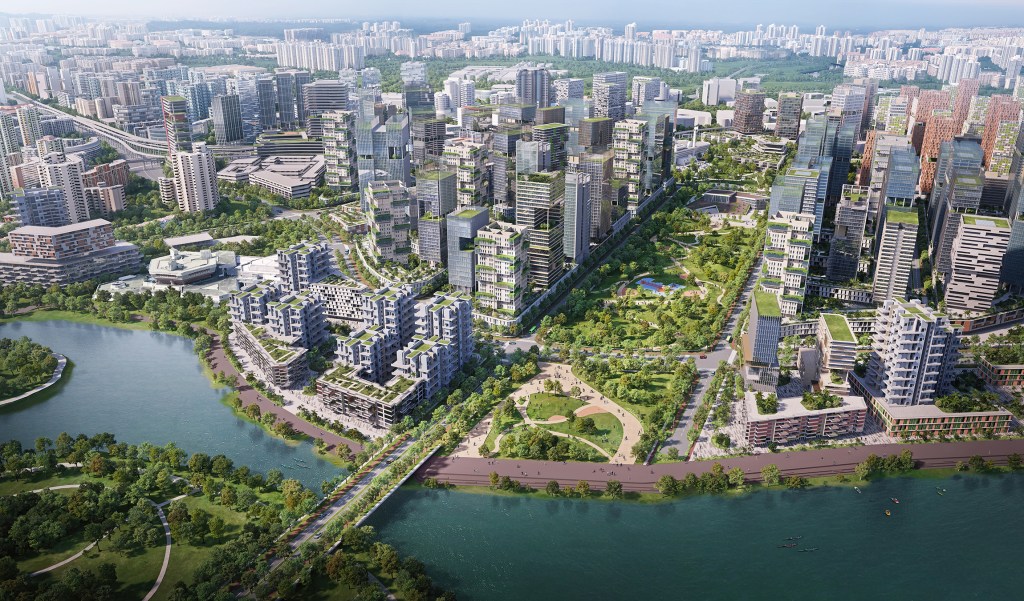
 Artist’s impression of Jurong Lake District – Singapore’s next largest business district and a world-class sustainability district.
Our next largest business district
Jurong Lake District will be the largest business district outside of the central area.
 Jurong Lake District will offer spaces to grow in a unique lake setting that blends the vibrancy and attractions of a CBD with greenery and water.
(Photography by Darren Soh)
The area around Jurong East MRT station today comprises offices, retail and institution uses. By 2028, more offices and community uses, a new Jurong Region Line station and an integrated transport hub will be built next to Jurong East MRT station.
%20JE%20ITH.jpg) Located at the heart of Jurong East, the Integrated Transport Hub comprises civic and community institutions, retail amenities and an office tower on top of a bus interchange.
Located at the heart of Jurong East, the Integrated Transport Hub comprises civic and community institutions, retail amenities and an office tower on top of a bus interchange.
(Image courtesy of LTA)
A new 120-hectare precinct will connect seamlessly to the existing commercial centre and MRT station via elevated pedestrian linkages and lushly planted streets. It will have a mix of offices, housing and amenities in a car-lite and park setting. With more flexibility in zoning, land tenure and phasing compared to other districts, companies can experiment with new development concepts and innovative ways to integrate live, work and play.
 Singapore’s first business park development to be certified Green Mark Platinum (Super Low Energy) is located in Jurong Lake District
(Image courtesy of Perennial Holdings Private Limited)
Jurong Lake District will be the focus of new development in the next two decades, with the government prioritising the sale of sites within the district.
A new, broad planning approach will be adopted for Jurong Lake District where flexi-use sites will be interspersed with business park uses. This will allow companies to locate all their activities and teams in one place. Large sites will give developers the flexibility to create scalable campuses tailored to business needs at competitive rents.
A dynamic ecosystem to grow your business
The West Region is also home to Singapore’s top two universities, providing a deep talent pool. Tuas Port, Jurong Innovation District and one-north are close by, making Jurong Lake District the ideal location to tap on academia for cutting-edge R&D, and to provide business and professional services to the maritime and high-value industries.
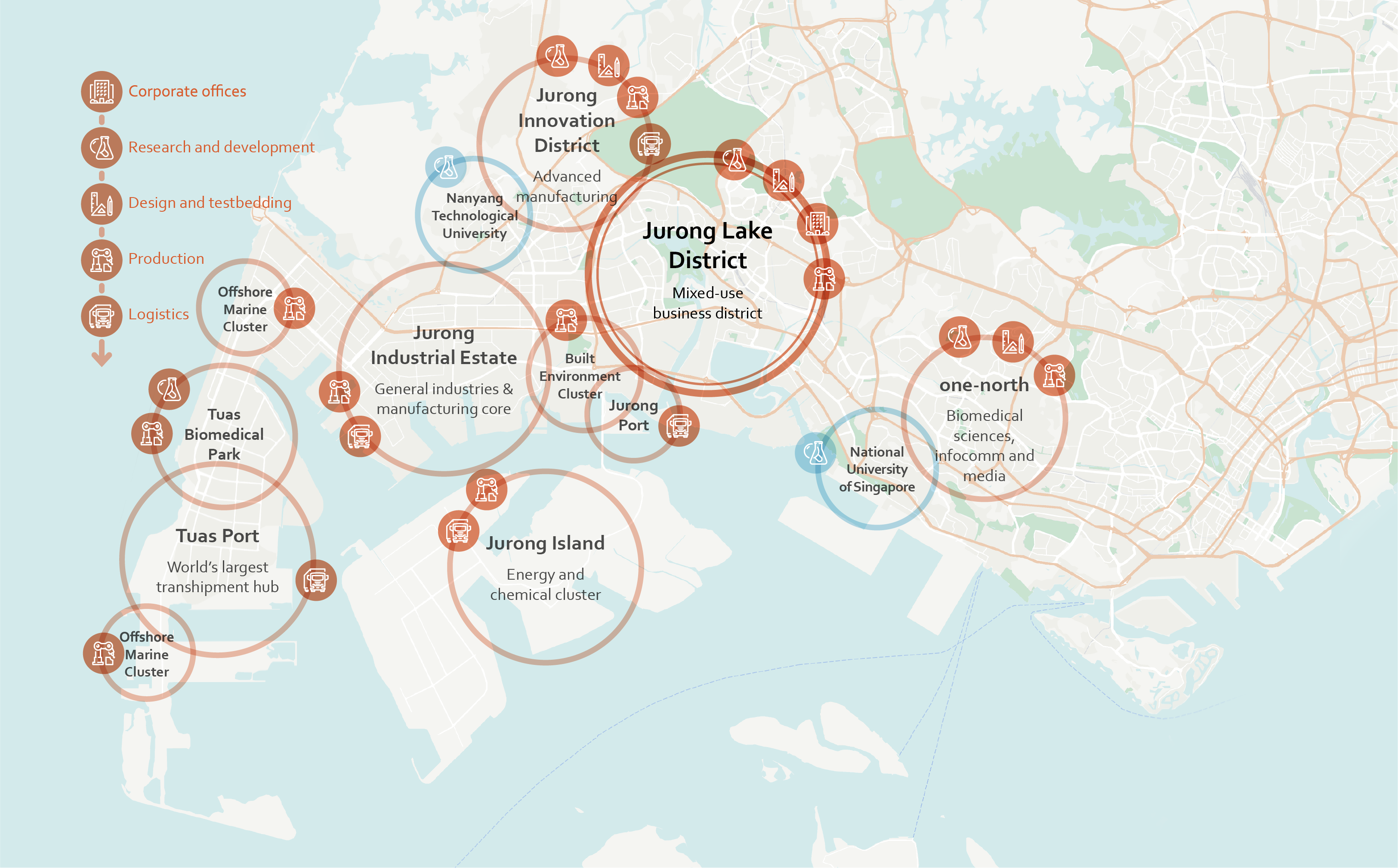
As the district grows, an ecosystem of innovation, collaboration and synergy within the region will emerge. Jurong Lake District will be a base for companies with strong Environment, Social, Governance (ESG) ambitions to tap on the West Region for opportunities in sustainability businesses.
By 2040 to 2050, Jurong Lake District will have 100,000 new jobs and 20,000 new homes, adding to the 1 million residents already in the West Region.
 Jurong Lake District is located alongside mature and established residential estates in the West Region.
(Photography by Darren Soh)
Fast connections to major hubs
Jurong Lake District will have excellent connectivity via two new train lines, Jurong Region Line and Cross Island Line, which are expected to be completed by 2029 and 2032 (for Phase 2) respectively. Together with the existing East-West Line and North-South Line, these new lines will connect people to major business centres and education hubs in the West and Central regions within 30 minutes.
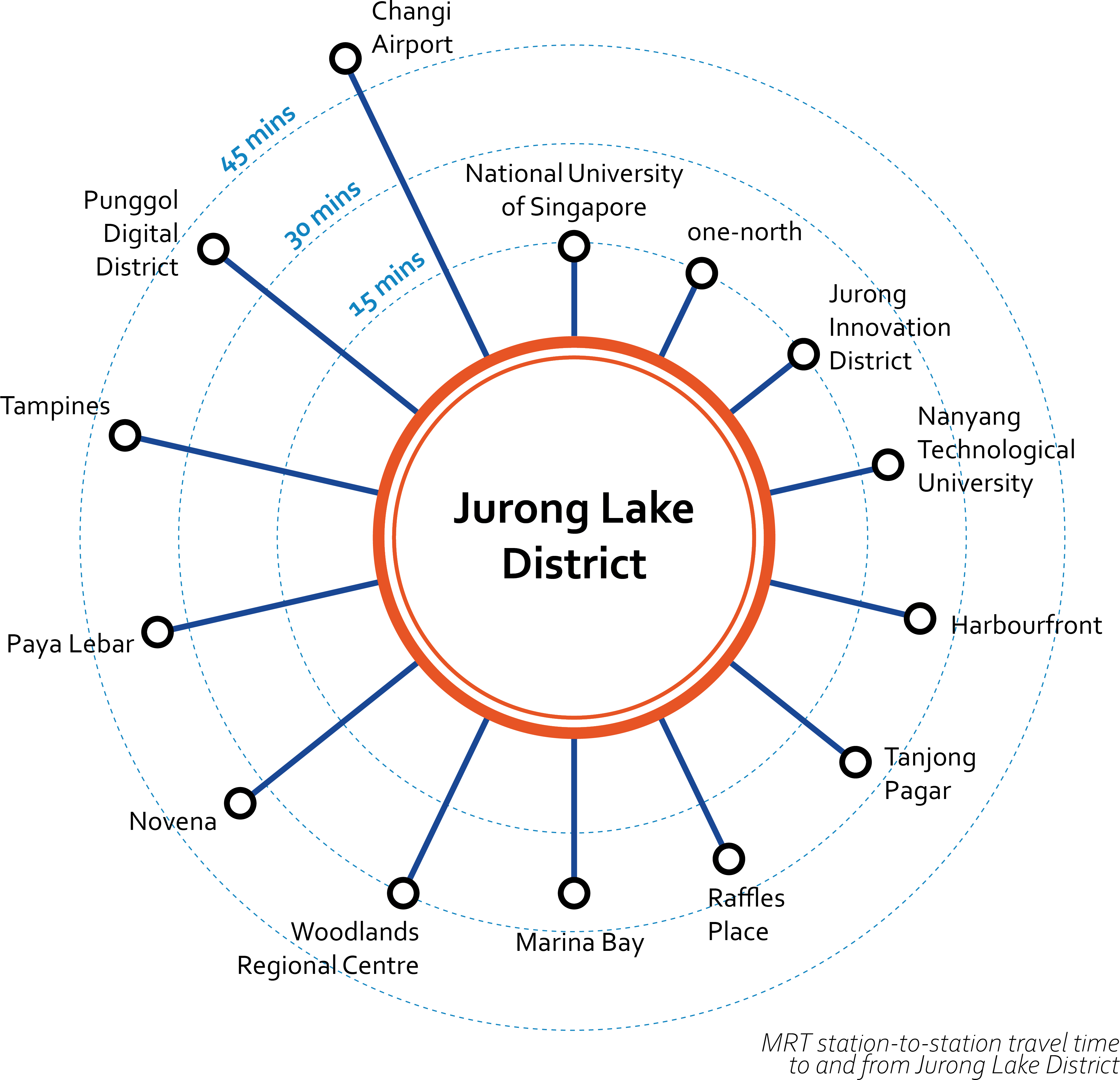
Jurong Region Line will link the district to academic expertise, R&D and skilled talent at Nanyang Technological University, Jurong Innovation District and Jurong Industrial Estate, where many high-value industries are located. The Cross Island Line will serve existing and future developments in the eastern, western and north-eastern corridors and connect Jurong Lake District to other major hubs such as Punggol Digital District and Changi Airport.
More than a CBD
Imagine working, living and playing in the district with convivial plazas, intimate public spaces, lush lakefront greenery and native fauna.
 Artist’s impression of the view corridor with the Jurong Town Hall monument.
A place to redefine live, work, play and learn
Jurong Lake District is ideal for the next generation of businesses and talent to redesign the way we live, work, play and learn.
 Artist’s impression of an open-to-sky courtyard that is designed as a extension of the surrounding streets.
Around Jurong East MRT station, residences at J-Gateway and offices at Jem, Westgate and Vision Exchange connect seamlessly to popular malls and major transport nodes. Devan Nair Institute for Employment and Employability offers programmes for continuous learning, and Ng Teng Fong General Hospital and Jurong Community Hospital serve the community’s healthcare needs.
 A wide variety of retail and food & beverage options are available at Jurong Lake District.
(Photography by Chee Boon Pin)
New inspiring work campuses that seamlessly integrate with parks, cafes, restaurants, retail, schools and homes will capitalise on the existing infrastructure to appeal to diverse and modern lifestyles.
Convenient city living in 10-minute neighbourhoods
Jurong Lake District will be made up of neighbourhoods where amenities, green spaces and public transport nodes will be within 10-minutes reach.
 Artist’s impression of the pedestrian networks coming together to form a fast-lane pedestrian route between the existing Jurong East MRT Station and the future Jurong Lake District MRT Station.
Lively campuses will house business and residential communities, where people meet and interact in generous open spaces and an attractive public realm. Throughout the district, retail, entertainment, healthcare, education, sports and fitness will all be within easy reach.
 Opportunities for sport, exercise and recreation will be within easy reach.
(Photography by Chee Boon Pin)
A district of gardens and water
Jurong Lake District will have more than 100 hectares of park and greenery, and a 70-hectare lake with more than 10 kilometres of active waterfront.
Throughout the district, streets are lined with canopy trees, forming green corridors that provide shade and act as nature ways for wildlife.
A central green spine will link every development to the edge of Jurong Lake, drawing in parks and forests to cool the urban spaces.
Water-sensitive urban design promotes climate resilience by channeling excess stormwater from urban spaces into the surrounding Jurong Lake.
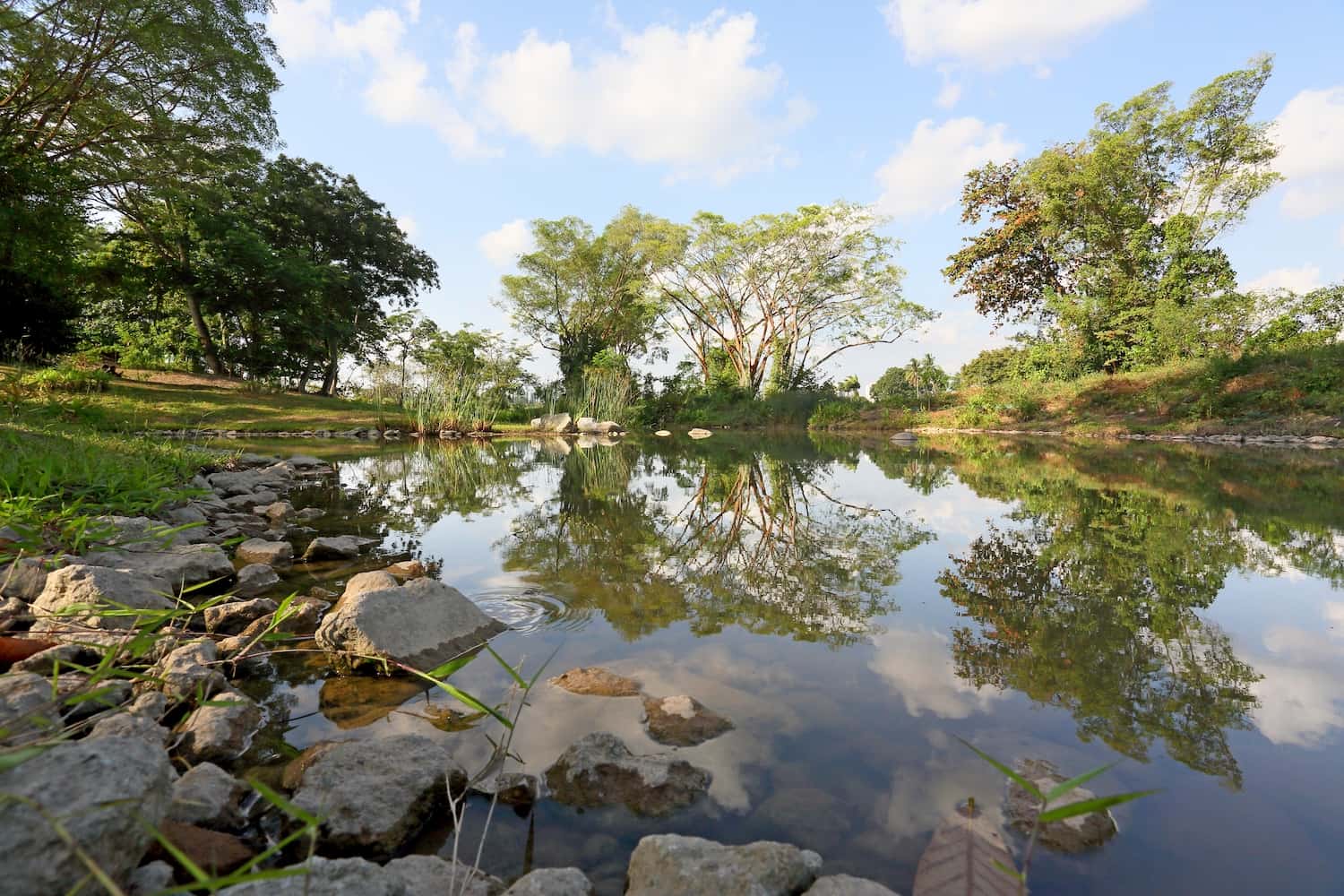 Neram Streams, a series of naturalised streams converted from a concrete drain, cleanses and channels stormwater runoff from the surrounding gardens into Jurong Lake.
(Image courtesy of NParks)
Jurong Lake Gardens provides opportunities for birdwatching and nature walks among vast grasslands and restored wetlands.
 Jurong Lake Gardens provides opportunities for birdwatching and nature walks in grasslands.
(Image courtesy of NParks)
In 2021, Lakeside Garden won an Urban Land Institute Asia Pacific Award for Excellence.
Signature attractions at the lake
Unique attractions will surround Jurong Lake, adding to the variety of recreation and water activities around the lake.
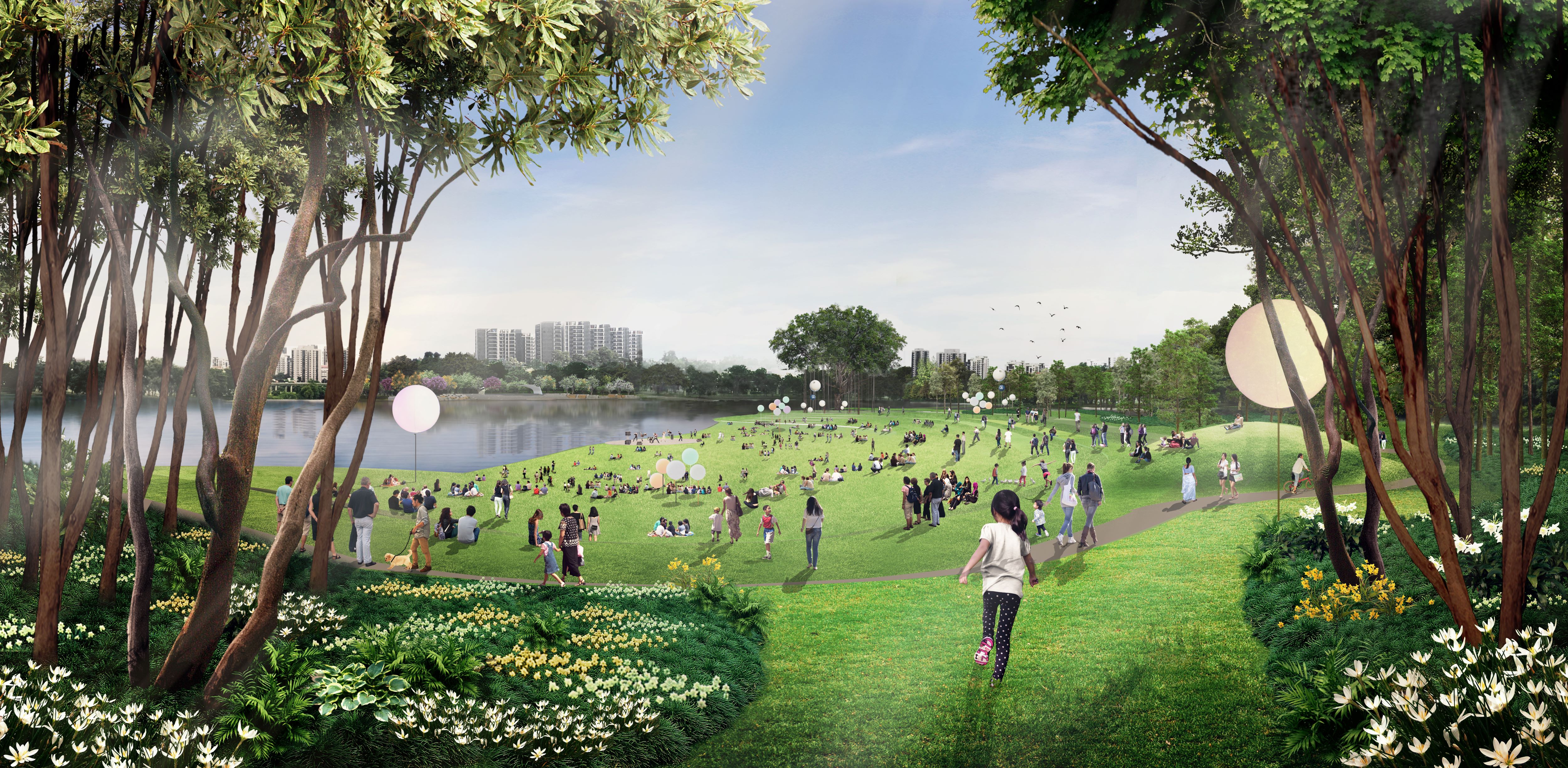 Artist’s impression of the new event lawn at Chinese Garden with views of the Pagoda and Jurong Lake.
(Image courtesy of NParks)
The redeveloped Chinese and Japanese Gardens will be completed in 2024. The new Science Centre, when completed around 2027, and a future tourism development will line the waterfront with exciting leisure and entertainment offerings.
Designed by Zaha Hadid Architects in collaboration with Architects 61, the new Science Centre will be Singapore’s biggest living lab to showcase real-world applications of science and technology. Its facilities, programmes and lush lakeside location will create an immersive learning experience in a one-of-a-kind space for visitors and residents in Jurong Lake District.
 A bird’s eye view of the new Science Centre.
(Image courtesy of Science Centre Board / Zaha Hadid Architects, for illustrative purposes only)
 With its convenient location at the doorstep of Chinese Garden MRT station, visitors will be able to spend the day exploring both Jurong Lake Gardens and the new Science Centre when it is completed.
(Image courtesy of Science Centre Board / Zaha Hadid Architects, for illustrative purposes only)
 Artist’s impression of gallery exhibits showcasing core scientific concepts.
(Image courtesy of Science Centre Board / Zaha Hadid Architects, for illustrative purposes only)
A new recreation corridor with active public spaces will link Jurong Town Hall to the existing Science Centre building.
These distinctive landmark buildings will take on new uses, continue to anchor the district and create a strong sense of place. They could become centres for co-working, innovation, museums, art studios, theatres, event grounds and playscapes with open spaces for the community to enjoy.
 Artist’s impression of the view corridor with the Science Centre Singapore main building.
Sustainable living
Connect to a ready sustainability ecosystem with people and businesses who care.
 Artist’s impression of an activated, pedestrian-friendly promenade along the water’s edge.
Primed for the green economy
At Jurong Lake District, residents and businesses will collectively shape a sustainable future through shared goals, higher standards and ready technology.
 Artist’s impression of an open-to-sky courtyard that is open to the public at all times and lushly landscaped
Identified as a model for urban sustainability under the Singapore Green Plan 2030, the district will support Singapore’s ambition to be a carbon services hub and a leading centre for green finance in Asia and globally.
Envisaged to attract a new generation of firms from the technology, e-commerce, sustainability and business services sectors, Jurong Lake District will be the epicentre to support talent and companies in creating new growth and new jobs in green innovation.
Government agencies leading Singapore’s sustainability, environmental, development and transport strategies are planning their move to Jurong Lake District in phases, attesting to the government’s commitment to making the district a demonstration for sustainable growth.
The district also acts as a “living lab” and regulatory sandbox, providing opportunities to pilot new urban solutions and refine sustainability-centric initiatives. The district has received interest to pilot proposals such as autonomous vehicle trials, ecologically-friendly leisure facilities and structures made from sustainable construction materials.
Building a model sustainable district
Jurong Lake District aspires to be a model sustainable district.
The six pillars encapsulate our ambitions for the district to achieve our net-zero emissions goal around 2045 for all new developments.
.jpg)
 Artist’s impression showing how the sustainability aspirations for Jurong Lake District come together in a typical development.
Pursuing sustainable transport
Jurong Lake District has high ambitions for green mobility.
By 2032, Jurong Lake District will be served by four MRT lines. At least 85% of all trips are targeted to be made by Walk-Cycle-Ride modes of transport by 2035.
 People can walk to their destinations comfortably along the J-Walk, an elevated weather-proof pedestrian network that links buildings, transit stations and public spaces throughout the district.
(Photography by Chee Boon Pin)
 Walk-Cycle-Ride trips will make up at least 85% of all trips to and from Jurong Lake District.
(Photography by Chee Boon Pin)
Key roads will be designed as Transit Priority Corridors, with bus-only usage lane, wider footpaths and cycling paths. The bus fleet serving the district will also comprise cleaner energy buses, including fully electric buses that will be deployed on feeder services by 2030.
 Artist’s impression of comfortable walkable streets lined with amenities.
Car parking provisions will also be lowered to reduce traffic and create a people-friendly environment.
The district will be designed to readily support autonomous vehicles for both passengers and goods. To encourage the electrification of private vehicles, EV charging points will be progressively deployed across the district.
 Autonomous vehicles at Jurong Lake Gardens are an example of a trial to prepare for the wider future deployment of AVs in the district.
(Image courtesy of NParks)
Enabling healthy living & building a city in nature
More than 100 hectares of land in Jurong Lake District has been set aside for parks and green spaces.
 Creating active communities through people-centric design at Jurong Lake District.
(Photography by Chee Boon Pin)
New buildings will achieve 100% landscape replacement, where greenery lost through development will be fully replaced by vertical greenery, sky terraces and landscaping.
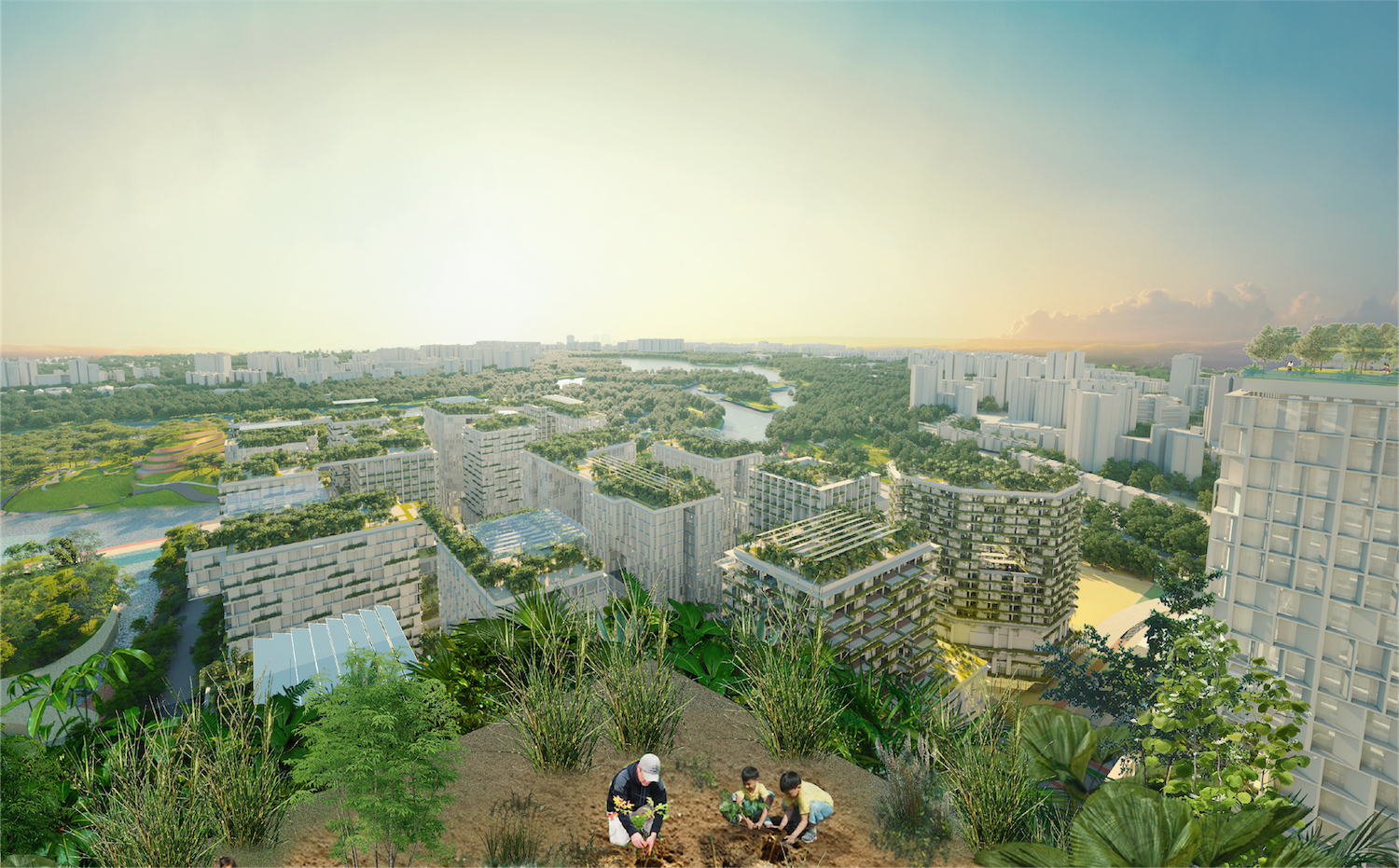 Artist’s impression of skyrise and rooftop greenery on buildings collectively forming a ‘green carpet’ in the sky.
(Image courtesy of KCAP Architects & Planners, SAA Architects, Arup, S333 and Lekker)
 Artist’s impression of developments with lush roofscapes offering amenities to support healthy lifestyles.
(Image courtesy of KCAP Architects & Planners, SAA Architects, Arup, S333 and Lekker and URA)
Thermal comfort, wind flow and shade analyses will be conducted at the development design phase to combat urban heat island effect, reduce energy consumed for cooling and create a comfortable environment for occupants.
 Greenery and natural ventilation at the Westgate Mall courtyard create a pleasant environment for shoppers.
(Photography by Chee Boon Pin)
Towards net zero emissions and zero waste
Embedded from the start, centralised district infrastructure will optimise the use of land and energy resources across Jurong Lake District.
 Artist’s impression showing how building design and management can contribute towards achieving net zero emissions.
All new buildings will be required to minimally achieve Green Mark Platinum (Super Low Energy) certification. Where feasible, we will aim for some developments to include Zero Energy Buildings. We will also deploy solar on all suitable surfaces within the district, not only on rooftops or building facades but also on vacant plots of land as a transitory measure to offset the district’s emissions while the national grid is decarbonised over time.
Jurong Lake District will be served by the District Cooling and District Pneumatic Waste Conveyance Systems. These systems could be housed in underground Common Services Tunnels to deliver cleaner and more efficient urban services to all buildings, which would also make our streets more pleasant by eliminating the need to dig up the road to lay utilities.
 Artist’s impression of how district infrastructure, vehicular circulation, deliveries and servicing will be located at the basement levels, freeing up the ground floor for more vibrant street life.
Advancing sustainability through partnership and innovation
Sustainability alliances will be formed among existing stakeholders in the district to adopt and share best practices, and work together to deploy solutions that address commonly encountered issues.
Businesses can tap on urban technologies to operate more efficiently and sustainably, and collectively demonstrate a greener way of life in an innovative district.
source: https://www.jld.gov.sg/



 My SG Property